Monday, May 5, 2014

4 May - Remembrance Day

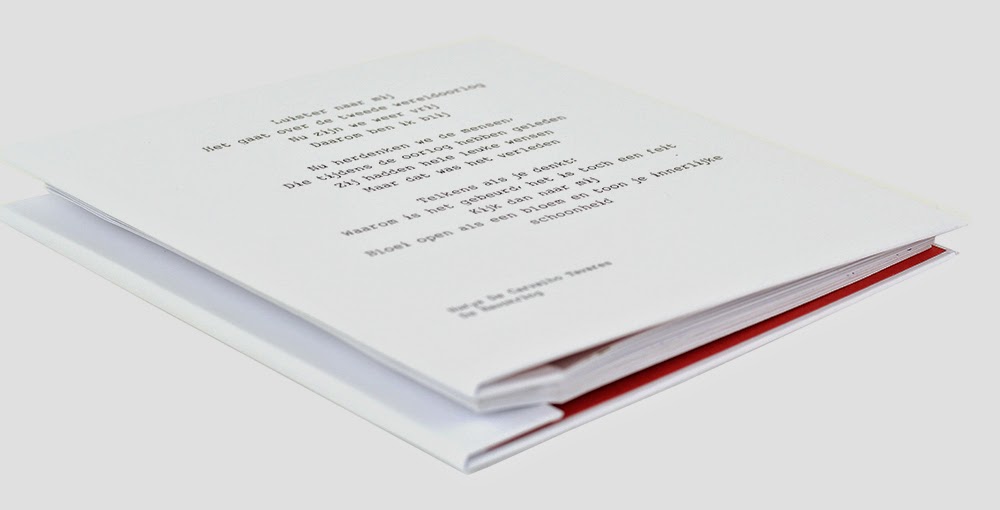
May 4th, a day to remember ... a day for remembrance. This day commemorates all civilians and members of armed forces of The Netherlands who have died in wars or peacekeeping missions since the outbreak of World War II. In Rotterdam mayor Aboutaleb together with prime minister Rutte were present at the Remembrance Ceremony in Crooswijk. Under the leadership of the ZangExpress, children of the Bavokring sang a song and handed over poems they wrote about Remembrance Day.

Prien has been commisioned by the ZangExpress to bind those poems into a booklet. It was such a nice assignment. The poems were really beautiful, some made me think, other made me laugh. I gathered some lines that stood out (in Dutch):

Vrijheid is vrij zijn
Vrijheid is blij zijn
vrijheid is voor ieder één
-----------------
Vrijheid is vrij zijn van de oorlog
iedereen mag vrij zijn
of je nou: turks, marokaans, afrikaans
antilliaans, surinaams, of chinees bent.
-----------------
We zijn nu vrij
dat maakt iedereen
blij. Zo moet het zijn.
-----------------
Ik heb een wens
voor de vrede. De mensen hebben
voor elkaar respect.
-----------------
Zonder vrijheid geen blijheid
gelukkig is de oorlog voorbij
-----------------
Voor al die mensen die ons hebben gered
wij allemaal vinden jullie een held
-----------------
Hitler hij deed erge dingen voor mensen
en hij droeg geen lenzen. Als hij dat zag
moest hij zien wat hij met de menshijd deed

Thank you very much for your poems and stories: Nurya, Cairo & Rohit, Dilda, Bafode & Jaden, Esmagül, Aymane & Volkan, Rana, Sara, Imane, Vanadil, Ilyas, Jamel, Bilal, Oguzhan, Moga,Thijmen, Kayra, Trishana.

www.prien.nl

www.prien.nl

Mark Rutte en Aboutaleb met ZangExpress boekje van Prien

Wednesday, April 30, 2014

Swan Market Antwerpen - Sunday, May 4th

The Swan Market goes international! This Sunday is the international kick-off in Antwerpen. Prien will be there as well. Curious to explore this new area :)

Hope to see you in Antwerpen this Sunday! The weather forecast is great, sun, little wind and 15 degrees ... an ideal day to wander around in this great city. Of course you can visit the Swan Market at De Grote Markt, a super central location. When you are in the mood for more shopping, this is the ideal Sunday to visit Antwerpen! Normally the shops are closed on Sunday, but this day it is Spring Midseason sale and the shops will be open!

Done shopping after the Swan Market, it is also nice to walk around and sightsee a bit. There are a lot of beautiful buildings such as Onze-Lieve-Kathedraal, de Bourla and Het Steen. Looking for something more modern, then choose the direction of Het Eilandje, this former harbour district has been transformed into a bustling area centered around Het MAS. This extraordinary building accomodates Museum aan de Stroom, a gathering of several museums. I really can recommend this museum, both the architecture and the exhibits are well worth the effort to visit! Another tip is Het Fotomuseum at the other side of the city; 't Zuid. When you walk from De Grote Markt to 't Zuid, one of the best ways is to take De Kloosterstraat, the place for antiques and flea. And don't forget to visit one of the thousand terraces or to eat at one of Antwerpen's great restaurants!

Want to know more about visiting Antwerpen, check out: http://www.allesoverantwerpen.nl/
Coming by car, you can park at the Grote Markt parking: http://www.antwerpseparkings.be/CMS/

Hope to see you Sunday! Prien will be there with Kim from Papiermonsters ... hopefully side by side :)


Monday, April 28, 2014

Favorite Illustrators

A few weeks ago Lisa from Elle Aime posted that she and Sarah Pronk would give an Illustration course. Since I really love her designs and since I was looking for something to relax from being a 24-hour entrepreneur, I registered for the course. Tomorrow I will join my third class, and I have homework to do...

First I have to bring a book wherefore I have to design a book cover. Each class we learn to work with a new illustration technique. This week we will make a collage by tearing pieces from books and magazines. Tearing pages from books ... sounds very scary :( ... the only comfort I have is that the old books will be used to create a new cover ...
I am still doubting about the book. Maybe I will take 'Nooit meer slapen' from W.F. Hermans, a famous Dutch writer. The book is about a geography student who gets lost in the North of Norway and is wandering around in the bush, losing his colleagues and himself. This book is also translated in English 'Beyond Sleep', I can strongly recommend it! But there is also IQ84 by Haruki Murakami and it's two moons ... also an interesting one for a book cover ...the two moons in a Japanese environment ... my fantasy is way far ahead of my hands :)

The other thing is that Sarah and Lisa keep on telling us that we have to draw every day ... and I try ... but it is so difficult on busy days! Yesterday I finally had a day off, and I actually draw some flowers ... so relaxing and inspiring to do. My goal is to do it more often ... just as going to yoga class :)

The third and last assignment for this week is to find three of your most favorite illustrators. I really love that one. It is good to think about it, although it is so difficult to pinpoint it to only three. I think each occasion requires a different illustrator. By the way, I have never noticed before that so many things are illustrated. Ok, at the moment it is very hip to illustrate your articles, adds or website, but it's not only because it is a trend ... illustrations are everywhere!
My favorite illustrators are:
- Tadahiro Uesugi 
     He is a Japanese illustrator who started as a fashion illustrator. He also worked a while as
     an assistant Manga artist. At the moment he creates elegant illustrations with a jazzy and
     classical sensibility. I recognize typical Japanese elements, combined with Paris with a
     touch of Hopper.


tadahiro uesugi

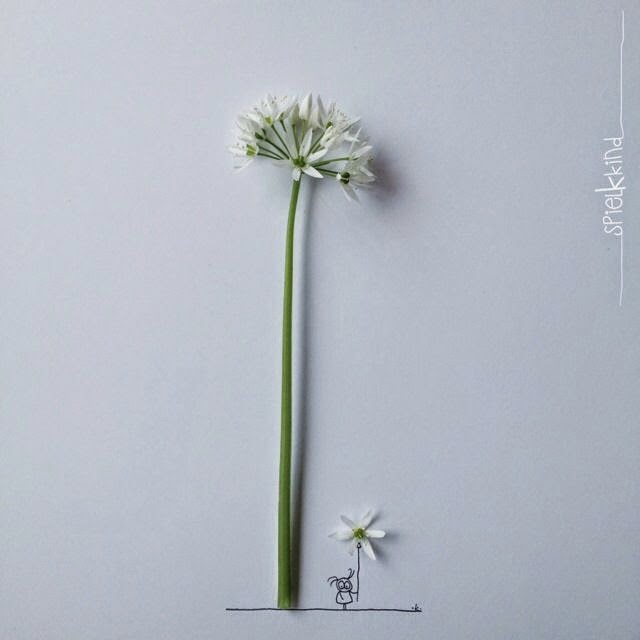
- Spielkkind
     She is a German teacher who combines every day things, such as flowers, food or rubber
     bands with sketch lines. I follow her blog, and every new blog post makes me laugh ...


Spielkkind illustratie

- Denise Holly Hobby-Ulinskas
      For old time sake I chose Holly Hobby, she is someone I grew up with. I might have drawn a
      thousand holly hobbies ... it is something from my youth I will never forget :) When my aunt
      passed away a few years ago we found a lot of small holly hobby drawing books ... she
      also loved her ... and she made a lot of small holly hobby paintings for me ...

Holly Hobby

Friday, April 25, 2014

Bogolan - nowadays

A few weeks ago I attended a workshop Bogolan - painting with mud from the river Niger -. Bogolan is an ancient way to paint and decorate cloths or fabric. By the 1970s, the bogolan tradition had nearly died out, because of a combination of the advancing globalization and the Malian struggle for independence. In the 1980s, through the efforts of cultural administrators and activists, as well as fashion designer Chris Seydou, Malians rediscovered the 'heritage' of Bogolan. The craft of bogolan soon mutated into two strains; bogolan mass-produced fabrics and fine art. The mass-production of bogolan serves the tourist and fashion markets and has become an important branch of the craft economy in Mali.


Painter Ismaël Diabaté helped transform the bogolanfini from a distinctly Malian clothing style to an internationally recognized fine art. In 1981 Diabaté started working with bogolan in his paintings. He believed that colonialism had undermined the Malian aesthetic and considered the mud-dyed technique part of a cultural revival. He combined the traditional technique with contemporary media and styles.

Fashion Designer Chris Seydou embraced Malian mudcloth in the 1980s as part of his heritage and delighted in its graphic quality. He simplified the older patterns, creating designs that tailored into Western style mini-skirts and jackets. The success of Seydou inspired a lot of young designers to use the bogolan technique in a modern way.


Also artists group Groupe Kasobane played an important part in rediscovering Bogolan. Mudcloth had only been used for clothing and these artists moved the technique from craftsmanship to art. Their innovation lies in the compositions, the style, the color range and in the presentation of works.


I learned a lot about Bogolan and I liked painting with the mud. It is very interesting to see how an ancient technique can be used in so many ways and I think it is very special that graphics that have been used for centuries still are so powerful. What I also learned is that this technique isn't a precise one, or one that is suitable for small delicate patterns. I don't believe I can use it to design and create a book cover. However, the patterns can also be used with different media. So .... in the future there will be book cover with Bogolan patterns ...


Friday, April 18, 2014

Original Market Leiden

This Sunday you can find Prien's products live at the Original Market in Leiden. In the garden, around the Rijksmuseum Volkenkunde in Leiden you can find a lot of creative entrepreneurs. The product range is very divers, from clothing to vintage to accessoires and not to forget stationery. Feeling a little hungry or thirsty after all the shopping .... just look for a food stand and enjoy a nice cup of coffee or eat a delicious tosty.

Hope to see you on Sunday! The new vintage collection will be for sale ... not even on the site yet ... just a short sneak peak in the blog :)

Enjoy your weekend!!

Sneak Peak Prien's Retro Series

Monday, April 14, 2014

Boekbindsbeurs Sint Niklaas

The Boekbindbeurs in Sint Niklaas was already on my wishlist for a few years. Curious if this fair is different from the bookbindfair in Leiden I wanted to check out this one, hoping for some new participants with new surprising materials or methods.

Since Sint Niklaas is situated between Antwerpen and Gent, two amazing cities to visit for a weekend, we chose Gent for our weekendtrip. We did some nice sightseeing, some shopping in between and we had good drinks and dinners, even the weather cooperated, so we also enjoyed some of the many terraces on the Gent squares and streets. Some of the nicest shops I want to share with you, just in case you pay a visit to Gent in the coming period - which I can recommend - :)
- Huiszwaluw                  interior and design products    
- Javana                            tea and coffee                        
- A.Puur.A                         cloths, interior and design      
- Le Pain Quotidien        lunch              
- Vintage                          wine and dinner
- Greenway                      veggie food        

In short we had a great weekend and in this relaxed mood we arrived at the Bauhaus in Sint Niklaas at the end of the morning. Unfortunately we weren't alone, we had to stand in line for more than half an hour to get in. We chose peak hour to arrive :(  Because it was so busy, we had a hard time trying to get a glimpse of the merchandise. Luckily the crowd decreased after a while and we were able to talk to some participants, such as the nice people of Louët. They are specialized in basic tools for bookbinding. Who needs big expensive machines if you can use the practical solutions of Louët. I bought myself a universal pricking gauge, so the pricking of the booklets will be so much easier and faster. Maybe in the future I will purchase the vertical plough as well. This stationery version of a plough makes really clean cuts for special editions.

Louet universal pricking gauge

There were not only participants selling bookbind stuff, but also some bookbinding and graphic design training institutes, such as TNA from Antwerpen, Syntra West from Brugge, the Academie from Genk and the Plantin Instituut from Antwerpen. The last one offers short courses and a longer curriculum for typography, its history and the practical use of it. Theoretical insights combined with the historical background, technical knowledge and practical skills of typography .... sounds amazing ... if I only had the time ... I would know !!

I also met some nice people from the 14 x 14 Boekbindproject (bookbinding project). This sympathetic bookbinding collective presents its project results in local libraries, on fairs and in a small inspiring 14 x 14 catalog. 


In comparison with the fair in Leiden, Sint Niklaas is smaller and there is much emphasis on leather and leather processing. Each time I see this beautiful and colorful material it starts to itch a little ... maybe I should learn how to process this material and give it a twist ... but I still have so many things to discover and working with leather is very expensive and the booklets bound with leather will also cost a lot more than the booklets I am making now ... so that means totally different customers ... so maybe later :)
For now the Boekbindbeurs in Sint Niklaas was inspiring and worth to visit ... but it is not necessary to visit both Leiden and Sint Niklaas ... one is enough :)  ... although the next one on the list is Keulen in October ... who knows :) ...

Tuesday, April 1, 2014

Bogolan - the patterns

Last Sunday I attended the workshop Bogolan from Rosalie van Deursen at the Vrije Academie in Amsterdam. I learned some interesting things about Mali and the history of Bogolan. For example, Rosalie told us the story of the genesis of Bogolan. Apparantly, a hunter with traditional yellow clothing colored with n'galama, had a deer with mud covered legs on his shoulders and this mud colored his cloths with permanent stains caused by the reaction between the mud and the n'galama cloth.

Bogolan is strongly connected to the social life in Mali. The symbolic imagery painted on clothing tells something about the situation of the owner: someone is married or marriageable, widower, pregnant or just became a father. Some examples of the traditional patterns and their meaning:

Tourousina: refers to jealousy between co-wives

N'gale: spinning tool
A wrapper or skirt for young women about to undergo Fourra, the Bamana coming of age ceremony for women.

Tamani

Basic symbols:
- a straight line                                -> the right path in life
- two parallel lines                         -> don't aim on two horses, you can't follow two lines in life
- one zig-zag line                             -> bad conscience
- one line with one zig-zag line    -> setting boundaries
- a cross                                             -> carrefour roads = trade = money = luck=prosperity
- fish bone                                        -> the man is the stable factor in the family


Of course this is only a small selection of symbols that are used for Bogolan painting. Every tribe has traditionally it's own symbols and nowadays a lot of symbols are adapted to modern style Bogolans. In my next blog I will show you some of these contemporary art works. 

Monday, March 24, 2014

Bogolan

This weekend I will dip my hands in the African mud. Ok, perhaps it will be a little bit less exciting than it sounds, because I won't go to Africa, but to Amsterdam... I will attend a workshop Bogolan, both cultural and practical. First we will learn somethings about the history of Bogolan and after this theoretical introduction we will dip our fingers in the mud.
Because I am really excited about taking this course, I am doing some research in advance. This blog is about the history and meaning of this special way to paint fabric, then there will be a blog about the meaning of the patterns and I will close this series with an overview of contemporary use of Bogolan.

Originally Bogolan is from Mali and the sub Saharan in West Africa. Bogolan, or bògòlanfini means made from mud in the Bambara language and has become the national symbol of Mali. This ancient way of painting on colored cotton is a longstanding tradition and a point of national pride. Bogolan and its patterns represent the culture of the Bamara, Dogon and Bobo people for generations. The Bogolan craftsmen are considered sacred or magical because of their material-altering nature, they complete the work 'begun by God'. Traditionally the Bogolan painting is only performed by men, just like the weaving of the textile. Narrow strips of cotton (15 cm.) are woven on looms. The only thing women contributed to this process was the spinning of the yarn, it used to be -and sometimes still is - a task of the grandmothers.
Nowadays the Bogolan-industry is very important for Mali. There is a kind of mass-production that serves the tourist and fashion markets, thereby the Bogolan craftsmen are no longer the only people producing these beautiful traditional products.

The Bogolan process is a 4-step process:
  1. Mud from the river Niger or it's tributaries contains iron, which makes it suitable for painting. The preparation of the mud/paint starts 2 to 4 weeks earlier. The mud is collected from the river, the best mud, which contains a lot of iron, is found in the middle of the river. In a big container the mud needs to be stirred from time to time, in this way the organic substances can degrade and the iron salts are released.
  2. After the cotton strips have been sewn together, they are first dyed, either a rich red from a dye obtained through boiling the bark of a n'peku, or in fresh yellow tones obtained through soaking the dried and pounded leaves of a n'galama. By mixing colors, or dipping the cotton several times a wide range of background colors can be created. The sun also plays a part in colouring the fabric. After each color-bad the cloths are unfurled in the sun to dry. The obtained colors represent the beautiful warm colors of the dessert, from dusk till dawn.
  3. Once the fabric is dyed it is ready to receive the mud. The patterns are drawn with charcoal, and the mud will be applied using a toothbrush, a bamboo stick or by using stencils. Through a process of oxidisation the salty mud reacts with the natural dyes of the dyed fabric. This chemical reaction produces a rich black when the mud has dried and been washed off. In order to reinforce the color of the mud, it can be applied several times, thereby the black will even be more intense. 
  4. After the mud has dried, the cloth can be softly cleaned, eventually with some soft soap. For the last time the cotton is laid out to dry in the sun. 


Friday, March 21, 2014

Prien at the Swan Market Sunday 23th

The kick off of the 2014 Swan Market season starts with a swinging festival in the Fenixloods. This robust, typically Rotterdam location is the place to be this weekend. Since it is inside, a little bit of rain now and then doesn't matter. There will be food and drinks and more important a lot of cool stuff. Looking for a nice present or something for yourself, don't hesitate and visit the market. It's for free! And there will be live performances as well.

Prien will attend the festival on Sunday. Where my stand will be, I don't know yet, hopefully next to Papiermonsters :)
I will have the new Spring Collection with me and the new Retro Summer Series ...
Hope to see you this Sunday! Enjoy your weekend!

Prien at the Swan Market

Thursday, March 20, 2014

Prien's New Spring Notebooks

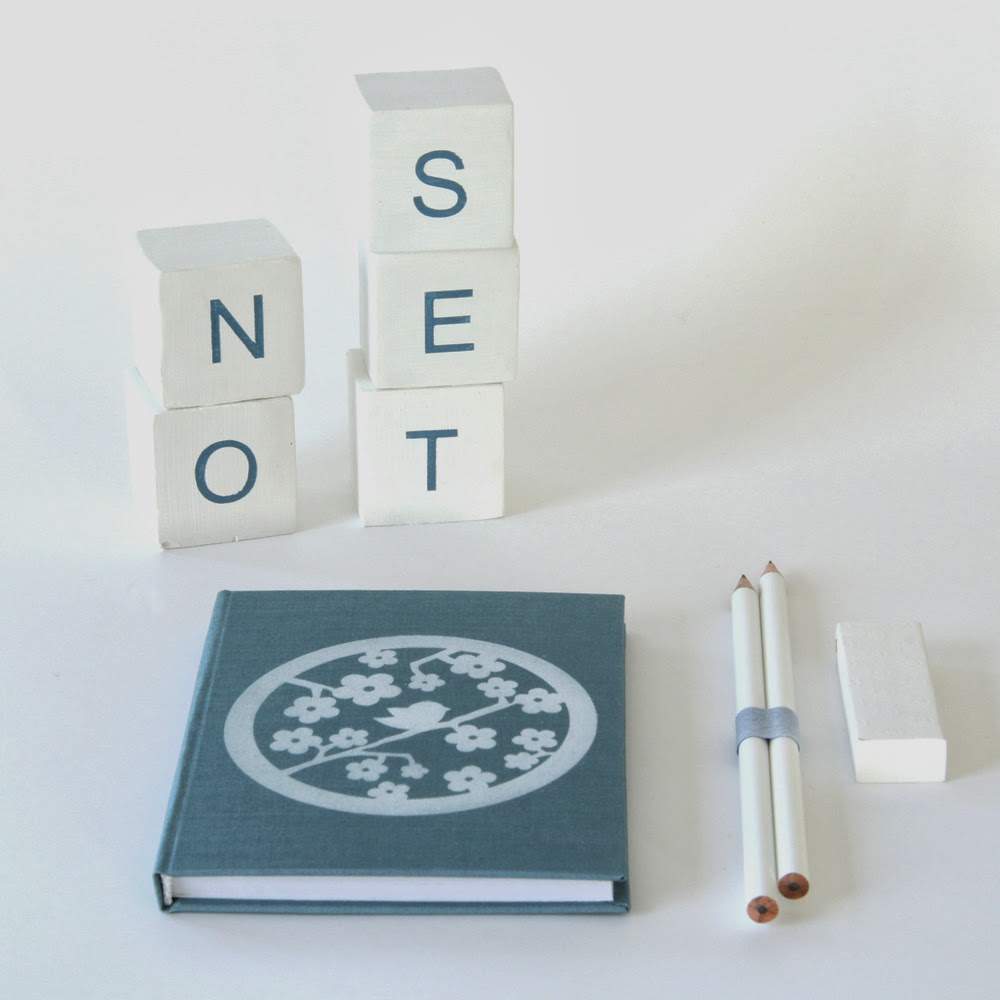
Spring is in the air ... so it's time for the traditional Spring Cleaning ... not only for your house, but also for your head. Prien's new notebooks will help you to get organized. These handy sized beautiful pastel notebooks fit in every bag, so you can always have one with you. Choose your colour and print and write down all your to-do-things. Sometimes you can make your live a little bit nicer, just by using the right equipment :)  Enjoy spring!!

Prien Spring Series Notebooks

Prien's Spring Series Notebooks
  
Prien's Spring Series Notebooks

Prien's Spring Series Notebooks